Skip to content

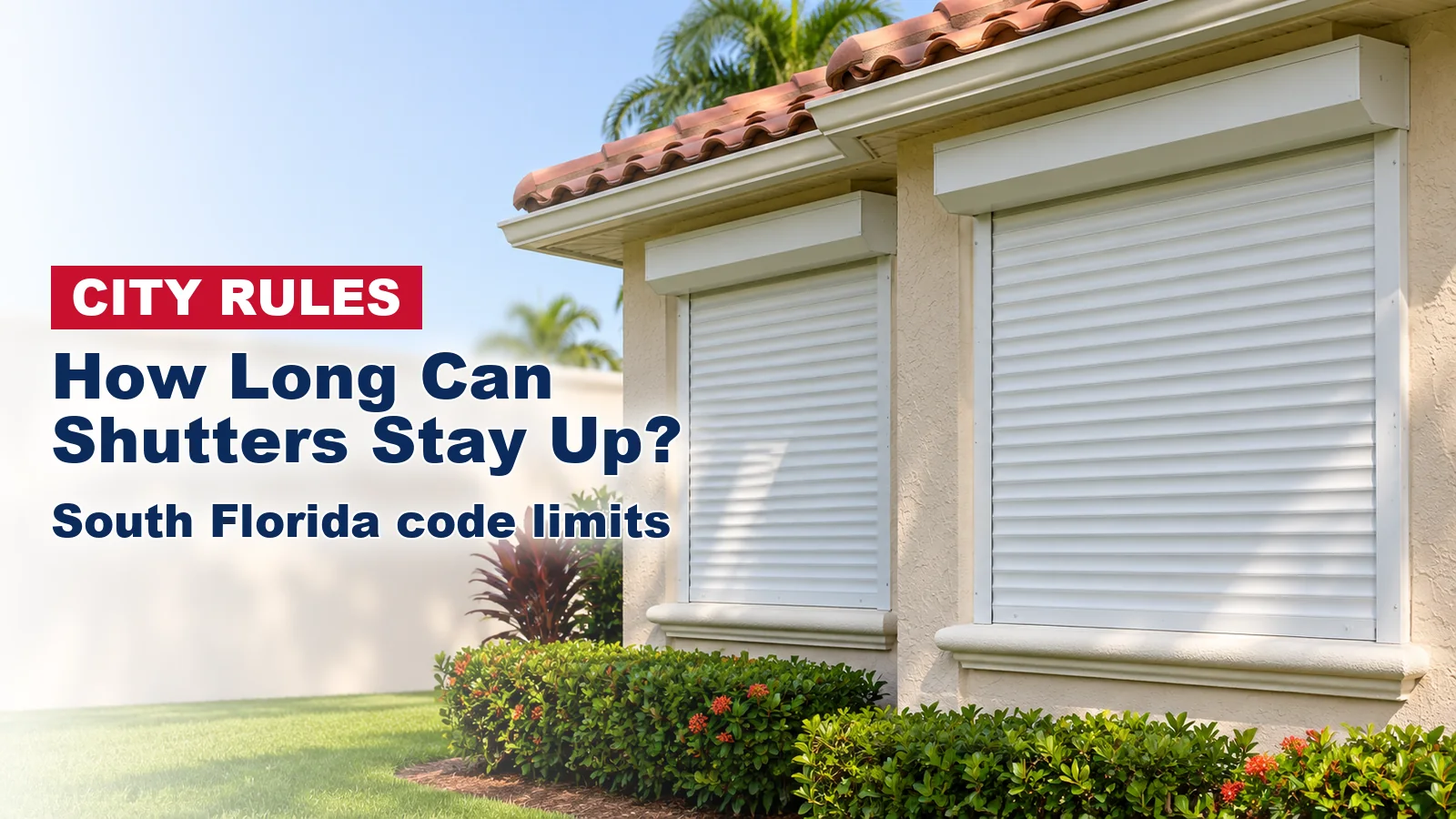
How long you can leave hurricane shutters up depends on your city. The Florida Building Code allows shutters over escape openings “during the threat of a storm” with no day count.
The six city codes here range from five days after a storm (Palm Beach Gardens) to 30 days after an emergency (Hialeah).
This guide quotes each city’s rule with its code section, explains why the limits exist, and shows what they mean for snowbirds. Rules vary and change, so check your own city’s code before you leave shutters closed.
Florida’s Statewide Rule: Shutters on Escape Openings During “the Threat of a Storm”
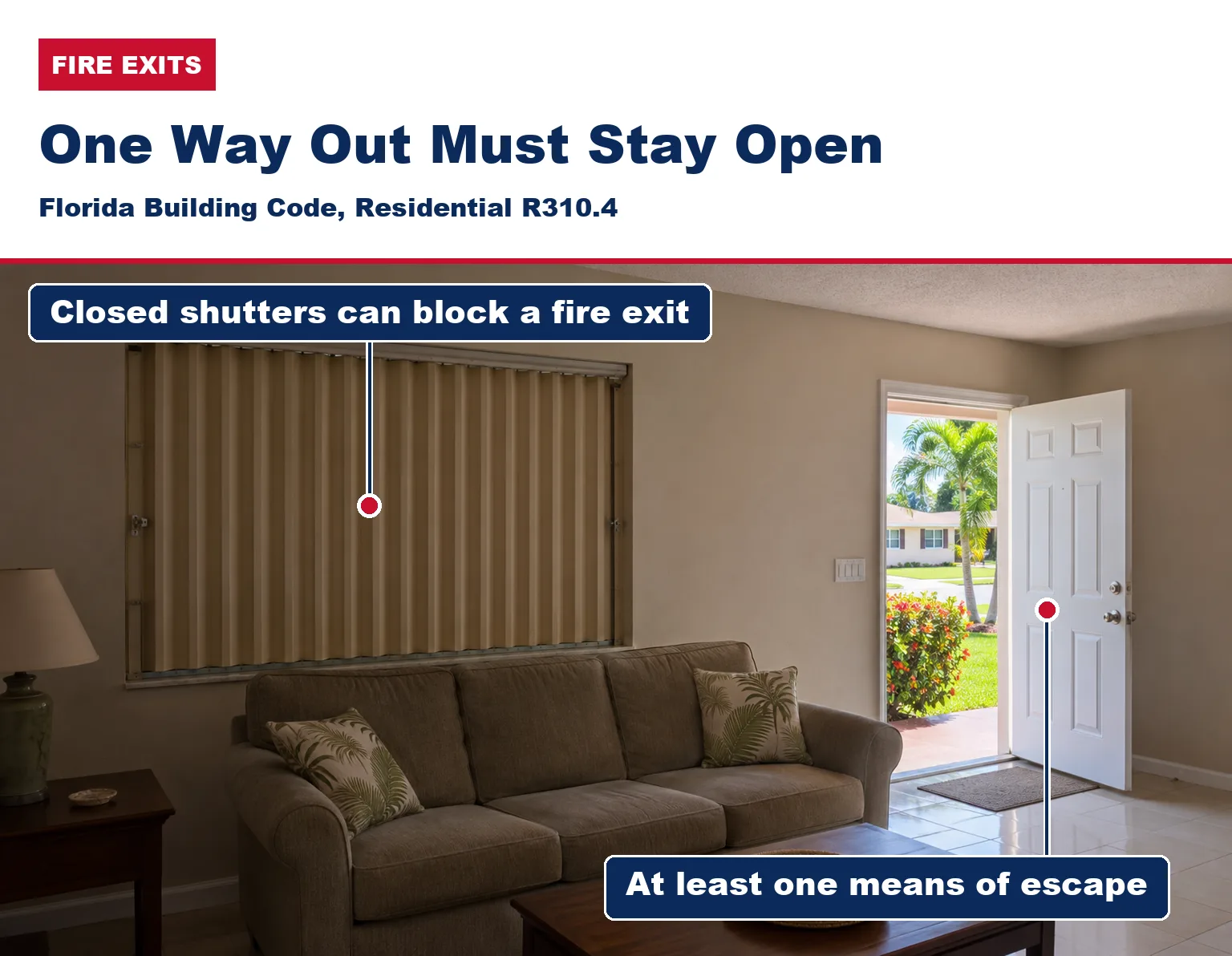
Florida’s statewide rule ties closed shutters on escape openings and exit doors to a storm threat. Section R310.4 of the Florida Building Code, Residential says closing storm shutters, panels and other approved devices “shall be permitted on emergency escape and rescue openings and egress doors during the threat of a storm.”
The same section sets a condition while the shutters are closed. At least one means of escape from the home must stay open, it must be on the first floor, and it cannot be in a garage unless the garage has a side-hinged door leading directly outside.
The building code puts no number of days on “the threat of a storm,” and many cities add their own limits. For the protection options themselves, see our guide on how to protect your windows during a hurricane.
South Florida City Rules on How Long Shutters Can Stay Up
South Florida city rules on closed shutters range from a few days around a storm to a month after an emergency. The table sums up six city codes, and the sections after it quote each one. Never assume a neighboring city follows the same rule.
| City (county) | Code section | Time limit for closed shutters | Empty or seasonal home |
|---|---|---|---|
| Hallandale Beach (Broward) | Sec. 14-12(b) | Panels off within 14 days after the county’s watch or warning is lifted (occupied buildings) | May stay longer if the owner leaves contact details as the code requires |
| Coral Springs (Broward) | Sec. 7-202 | No more than 14 consecutive days; outside June 1 to November 30, only during a watch | Exception when no one is in residence; vacancy dates go to the fire department June 1 to November 30 |
| Weston (Broward) | Sec. 62.02 | Only while the city is in the NHC five-day cone, and 10 days after | Allowed on an unoccupied home June 1 through November 30 |
| Hialeah (Miami-Dade) | Sec. 50-30 | Removed no later than 30 days after a declared emergency ends | Allowed to secure a vacant dwelling during the vacancy |
| Palm Beach Gardens (Palm Beach) | Sec. 86-29 | Up to 5 days before forecast landfall and 5 days after the storm passes | No separate exception in the section |
| Boynton Beach (Palm Beach) | Local amendment 110.10 | Removed within 15 days after a watch or warning ends, if they block required egress, light or ventilation | The rule names occupied buildings |
If you would rather not track any of these clocks, look at impact windows we install from ES Windows, which protect the opening with nothing to close or remove.
Hallandale Beach: 14 Days After the Watch or Warning Is Lifted
In Hallandale Beach, Code Section 14-12(b) says that when a home or building is protected by a hurricane protection system, “the panels must be removed within 14 days after the lifting of a hurricane warning or hurricane watch for the county if the building is occupied.”
An unoccupied Hallandale Beach home may keep panels up longer than 14 days if the owner gives contact information to the property manager or condominium association president. With neither, the owner must notify the Department of Development Services.
The Hallandale Beach city manager can require removal at any time.
Coral Springs: 14 Consecutive Days, and Only During a Watch Off-Season
Coral Springs has two limits in Code Section 7-202. Shutters that “impede egress, light, and/or ventilation” may not stay closed on occupied buildings after a hurricane watch or warning has ended, and no shutters may stay closed “for periods in excess of fourteen (14) consecutive days” unless an exception applies.
The Coral Springs exceptions are two clear paths of egress from every story, a new watch (which restarts the 14 days), a watch predicted within 48 hours after day 14, or a home where no person is in residence.
Outside June 1 to November 30, Coral Springs allows closed shutters only during a hurricane or tropical storm watch.
Weston: The Forecast Cone Plus 10 Days
Weston ties closed shutters to the forecast. Code Section 62.02 bans closed shutters except while the city is in the NHC’s five-day Track Forecast Cone for a tropical storm or hurricane, “and for a period of ten days after the City is no longer within any five-day Track Forecast Cone.”
Weston’s other exceptions are an unoccupied home at any time from June 1 through November 30, up to 24 hours for testing and maintenance, and an extension issued by the city manager. Homeowners comparing options can also read about impact window replacement in Weston.
Hialeah: 30 Days After a Declared Emergency Ends
Hialeah counts from the end of an emergency. Code Section 50-30 says shutters, panels, accordions or awnings “shall be removed no later than 30 days after the declared emergency has ended or elapsed,” and the count restarts if another emergency is forecast within 72 hours after day 30.
Hialeah also allows closed shutters for up to 30 days over a broken window or door, and “to temporarily secure a vacant dwelling or commercial property during the period of vacancy.” When not in use, pre-installed shutters must stay opened and unlocked, and all panels must be taken down.
Palm Beach Gardens: 5 Days Before Landfall, 5 Days After
Palm Beach Gardens allows closed shutters only around a forecast storm. Code Section 86-29 says closing hurricane shutters “of any type whatsoever” is “strictly prohibited,” except when part of Palm Beach County is in the NHC five-day cone for a named storm.
In that case, Palm Beach Gardens allows shutters up to five days before the forecast landfall, and they “may remain in place for no more than five days following storm passage.” The section has no separate exception for empty or seasonal homes.
Boynton Beach: 15 Days When Shutters Block Exits or Light
Boynton Beach puts its rule in the city’s local amendments to the Florida Building Code. Section 110.10 says that after a National Weather Service hurricane watch or warning ends, shutters on occupied buildings “which impede required egress or required light and ventilation shall be removed within 15 days.”
Fort Lauderdale and Other Cities: Check Your Own Code
Fort Lauderdale’s Code Section 18-9 deals with boarding up buildings, not with how long shutters stay closed. It lists “Unoccupied residences secured with storm shutters” among the cases that need no boarding certificate.
Fort Lauderdale homeowners can also see our impact window service in Fort Lauderdale.
For Fort Lauderdale and any other city, search the code of ordinances for “storm shutters” or call code compliance.
Why Cities Limit Closed Shutters: Fire Exits, Light and Upkeep
The codes point to fire safety first. Closed shutters can block a fire exit, and the state code requires one means of escape on the first floor while shutters are closed. Coral Springs and Boynton Beach target shutters that impede egress, light and ventilation.
Some city councils state the reason in the code itself. Palm Beach Gardens found that closing shutters outside a storm threat “constitutes an imminent threat to the health, safety, and welfare to the public at-large.” Coral Springs places its rule in the city’s fire prevention code.
Upkeep and code enforcement also show in the codes. Hallandale Beach places its limit in its Minimum Property Maintenance and Occupancy Code, next to rules for boarded buildings, and Hialeah sets civil penalties for violations.
What the Shutter Rules Mean for Snowbirds and Seasonal Homes
For snowbirds, the rules raise two questions: can shutters stay closed while the home is empty, and can they be closed before June 1? The answer depends on the city.
- Coral Springs: the 14-day limit does not apply while no one is in residence, and from June 1 to November 30 the owner must also give the fire department the vacancy dates on its form.
- Hallandale Beach: an unoccupied home may keep panels up longer if the property manager, condo association president or Development Services has the owner’s contact details.
- Weston: an unoccupied home may keep shutters closed from June 1 through November 30.
- Hialeah: Section 50-30 allows shutters “to temporarily secure a vacant dwelling or commercial property during the period of vacancy.”
- Boynton Beach: the 15-day rule in Section 110.10 names occupied buildings; ask the city how it treats an empty home.
- Palm Beach Gardens: no separate empty-home exception, so shutters follow the cone rule.
The off-season catch matters if you leave in April or May. Before June 1, Coral Springs allows closed shutters only during a watch, and Weston only for the forecast cone or another listed exception.
Plan this before you leave: find your city’s section, file any vacancy notice, and brief a local helper on the deadlines. Our checklist for closing up a Florida home for the summer covers the rest of the house.

Impact Windows: The Option With No Shutter Clock
Impact windows remove the shutter deadline for every opening they protect. In Florida’s wind-borne debris region, FBC Residential Section R301.2.1.2 requires glazed openings to be protected from windborne debris, and an impact-rated window does that by itself.
Coral Springs says it plainly on its window and door permit checklist: “Shutters not required for Impact Resistant Windows.” With nothing to put up, there is nothing to take down by a city deadline.
Sliding glass doors and entry doors are openings too, so plan impact doors for South Florida homes with the windows. Any opening left without impact glass still needs a shutter plan.
For the full trade-offs, compare impact-resistant windows and hurricane shutters side by side, check when Florida requires impact protection, and see what drives the cost of impact windows in Florida.
Timing matters for seasonal owners. At USA Home Improvement, manufacturing takes about 6 to 8 weeks depending on project scope, and installation averages 1 to 2 days. The whole process is about 3 months start to finish, though it can vary, so start early in your winter stay.
We sell ES Windows exclusively, in aluminum and vinyl frames, every project is permitted, and our installation team holds direct certification from the manufacturer. Request a free estimate for impact windows or call (877) 554-6373. Our complete guide to impact windows in South Florida covers styles and county rules.
Hurricane Shutter Time Limit FAQs
Can I leave my hurricane shutters closed all summer?
Only if your city allows it. Weston allows it on an unoccupied home from June 1 through November 30, and Coral Springs lifts its 14-day limit while no one is in residence (file the vacancy dates with the fire department). Hallandale Beach and Hialeah also have empty-home rules.
Can I be fined for leaving shutters up too long?
Yes, in some cities. Hialeah’s Section 50-30 sets a civil penalty of $150 for the first offense and $300 for each later violation, and Coral Springs fines violators under its Section 1-8.1(d). Check your own city’s penalty section.
Do the rules apply to accordion and roll-down shutters, or only panels?
Most of these rules cover every type. Palm Beach Gardens says “of any type whatsoever,” and Hialeah names shutters, panels, accordions and awnings. Hialeah adds that pre-installed shutters must stay opened and unlocked when not in use, with all panels taken down.
How early can I put my shutters up before a storm?
That depends on the city. Weston and Palm Beach Gardens tie it to the National Hurricane Center’s five-day forecast cone, and Palm Beach Gardens allows up to five days before forecast landfall. Coral Springs allows closed shutters outside June 1 to November 30 only during a watch.
Can my condo association or HOA set its own shutter rules?
Yes, within limits. Florida law has condo and HOA boards adopt hurricane protection specifications, and city time limits still apply on top of them. In Weston, Section 62.03 adds that any shutter type meeting the Building Code may be installed, notwithstanding association rules.
Check Your City’s Rule Before You Close Up the House
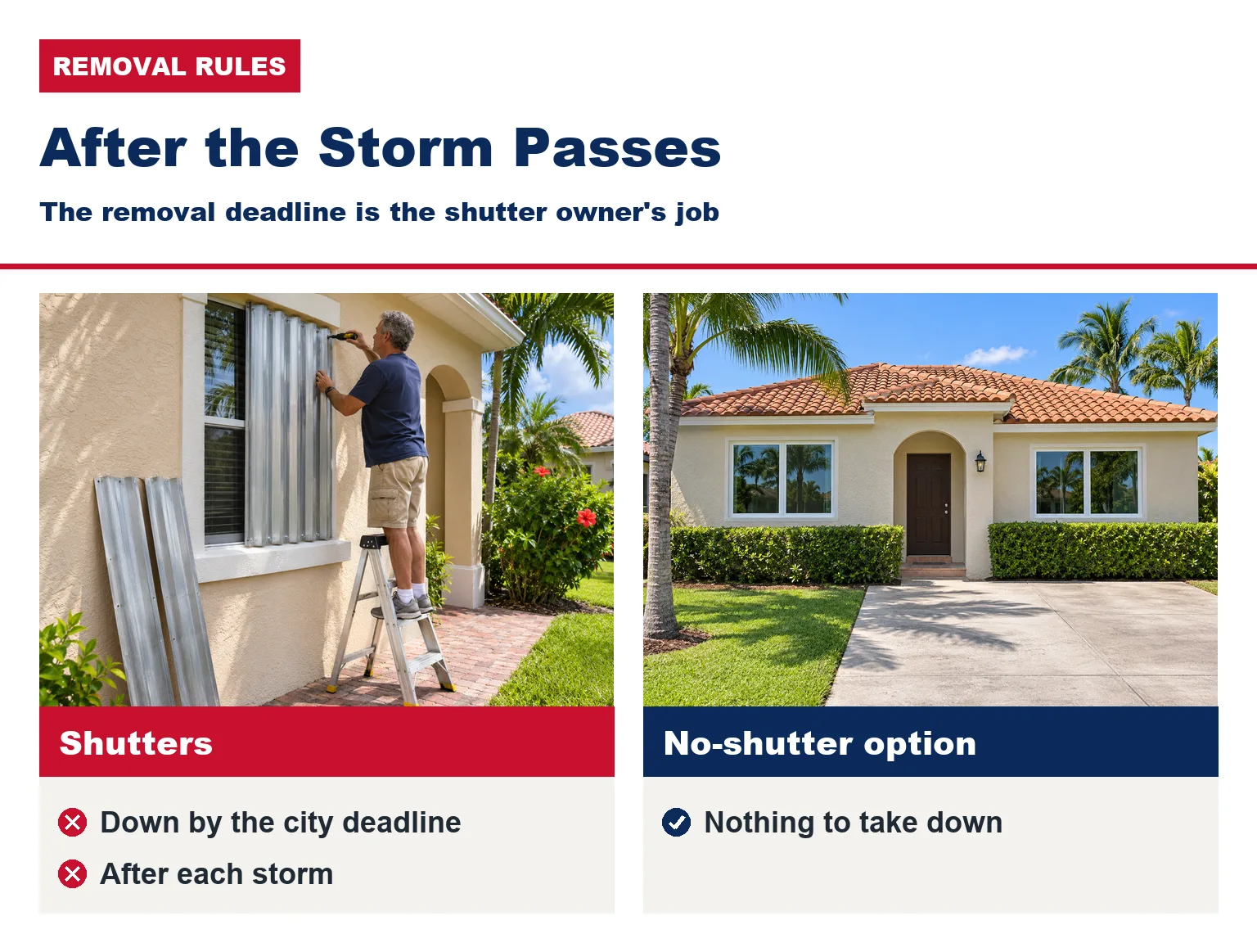
If you rely on shutters, look up your city’s section before you leave for the summer, and set a reminder for the removal deadline after each storm. If deadlines, notices and helpers are the hard part, impact windows and doors take the shutter clock off your list.
Financing may be available for qualified homeowners through independent third-party providers. Terms, eligibility and availability depend on the program and location. See how project financing works.
USA Home Improvement is licensed (CGC1526707) and insured and has served Florida homeowners for more than 15 years.
Get a free estimate or call (877) 554-6373.